
Did you know over 159 million American adults ages 18 and above are Hypertensive?
Posted by Medical Device Depot Inc. team, co-authored and inspired by the innovations of Baxter International Inc. on Apr 1st 2026
That’s not a statistic. That’s an alarm bell.
Behind every “quick” blood pressure check in a busy clinic is a make-or-break moment: get the technique wrong, and you can turn a silent killer invisible or create a disease that isn’t there. Combating hypertension misdiagnosis doesn’t start with a prescription pad. It starts with better blood pressure technique.
The Hidden Danger: Misdiagnosis by Bad Technique
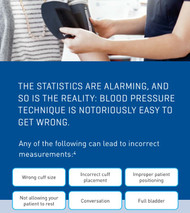
Hypertension can lead to heart attack, stroke, and kidney damage but only if we see it coming and treat it in time. When technique is sloppy, readings can lie. A cuff that’s too small, a patient with crossed legs, a rushed measurement right after a walk from the parking lot, can all impact readings and diagnoses.
The result? Some patients with dangerous hypertension walk out unprotected, while others live with the label “hypertensive” based on numbers that never should have been trusted.
It Starts Before the Cuff Goes On
Imagine this: your patient just had a coffee, rushed up the stairs, and is scrolling their phone when they’re called in. You slap on a cuff and hit “start.” That reading looks official, but it’s not accurate.
To fight misdiagnosis, the basics matter:
- No smoking, caffeine, or exercise for 30 minutes before the reading.
- Empty bladder first. Yes, it really affects the numbers.
- Sit quietly for five full minutes, back supported, feet flat, legs uncrossed.
- Arm supported at heart level, not dangling in mid‑air.
It feels slow, but it’s one of the fastest ways to help improve the quality of your hypertension care.
The Cuff Is Useful… If You Use the Right One
Using the wrong cuff size is like weighing a patient on a broken scale. Too small, and readings are often falsely high. Too large, and you can underestimate their risk.
Instead of guessing:
- Measure mid-upper arm circumference.
- Choose a cuff with bladder length > 80% and width > 40% of that arm size.
- When in doubt between two sizes, go larger, not smaller.
- Place it on the bare upper arm, centered over the brachial artery, with just space for two fingers under the cuff.
According to one study of 165 people, when a cuff is too small, 39% of people can be misclassified as being hypertensive and if a cuff is too large, 22% can be missed as being hypertensive.
Stop Trusting Single Numbers: Use BP Averaging
One rushed reading in an exam room should not decide someone’s diagnosis. Modern automated office blood pressure (AOBP) devices with averaging are designed to help fix that.
Here’s how to raise your game:
- Take at least two readings, at least one minute apart.
- Use the average of the measurements as your decision point.
- Let automated devices handle the timing and calculations, so you can focus on the patient.
- Connect your devices to the EMR to help eliminate manual transcription errors.
With devices like Welch Allyn automated vital signs monitors from Baxter, you can utilize accurate measurement and connectivity to the EMR.
Technique Is Treatment
Every time you measure blood pressure, you’re not just “collecting vitals” you’re either sharpening or dulling one of the most important diagnostic tools in medicine.
Good technique:
- Helps protect patients from silent, untreated hypertension.
- Helps prevent unnecessary medication based on bad data.
- Builds trust when you explain, clearly and confidently, “These numbers are accurate and here’s what they mean.”
If you want to help combat hypertension misdiagnosis, don’t just look at the numbers on the screen. Look at how you got them.
This article is inspired by educational materials developed by Baxter International Inc. Baxter, Welch Allyn, Connex, Hillrom, Spot Vital Signs, and SureBP are trademarks of Baxter International Inc. or its subsidiaries, referenced here with attribution.